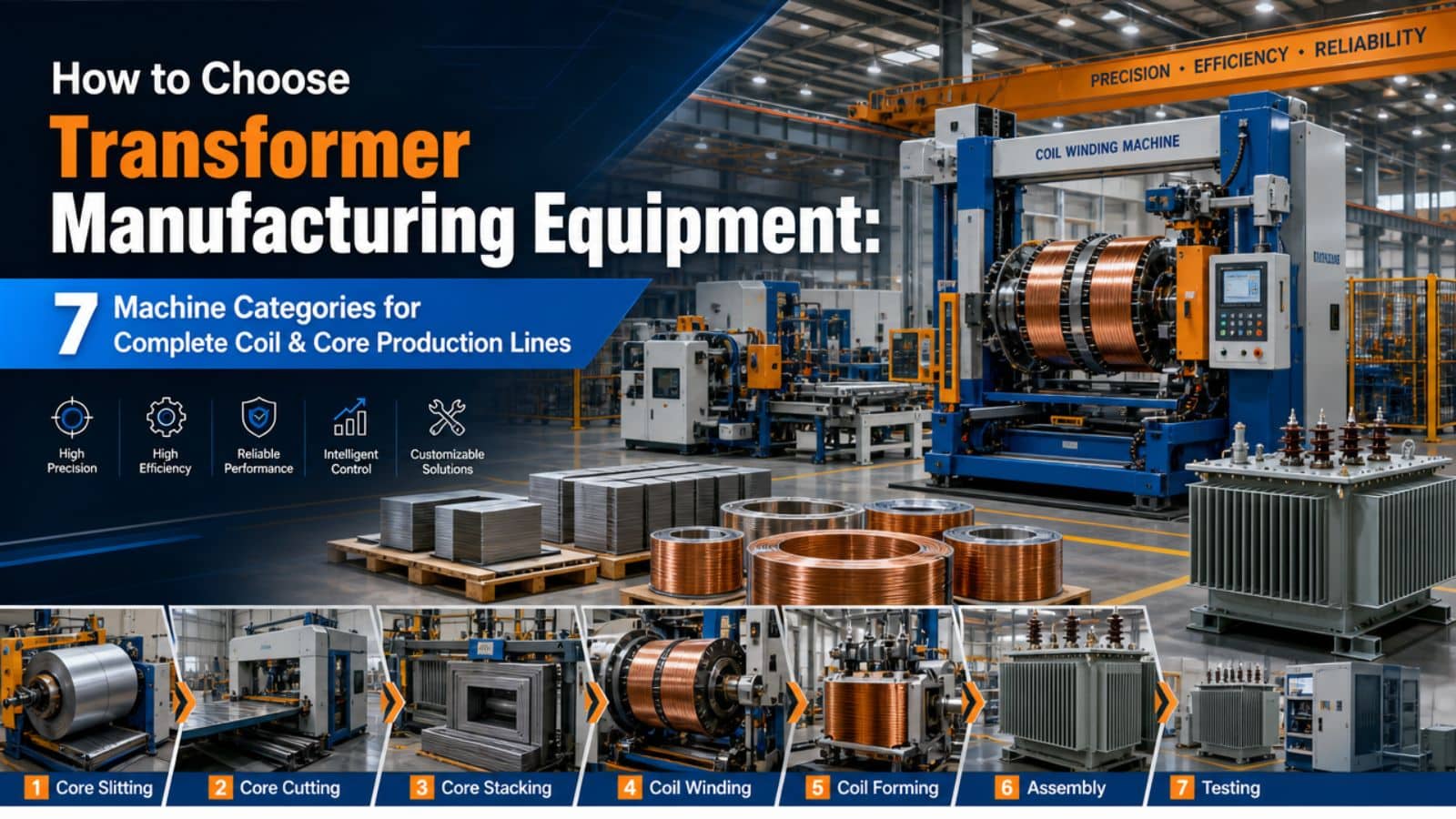
Building or expanding a transformer factory requires more than buying individual machines. It requires a production system where winding, core building, insulation fabrication, coil assembly, drying, and vacuum treatment are balanced for throughput, quality, and capital efficiency.
This guide walks through the seven essential equipment categories that make up a complete transformer manufacturing line, with selection criteria and integration considerations drawn from real-world factory layouts.
Category 1: Winding Equipment
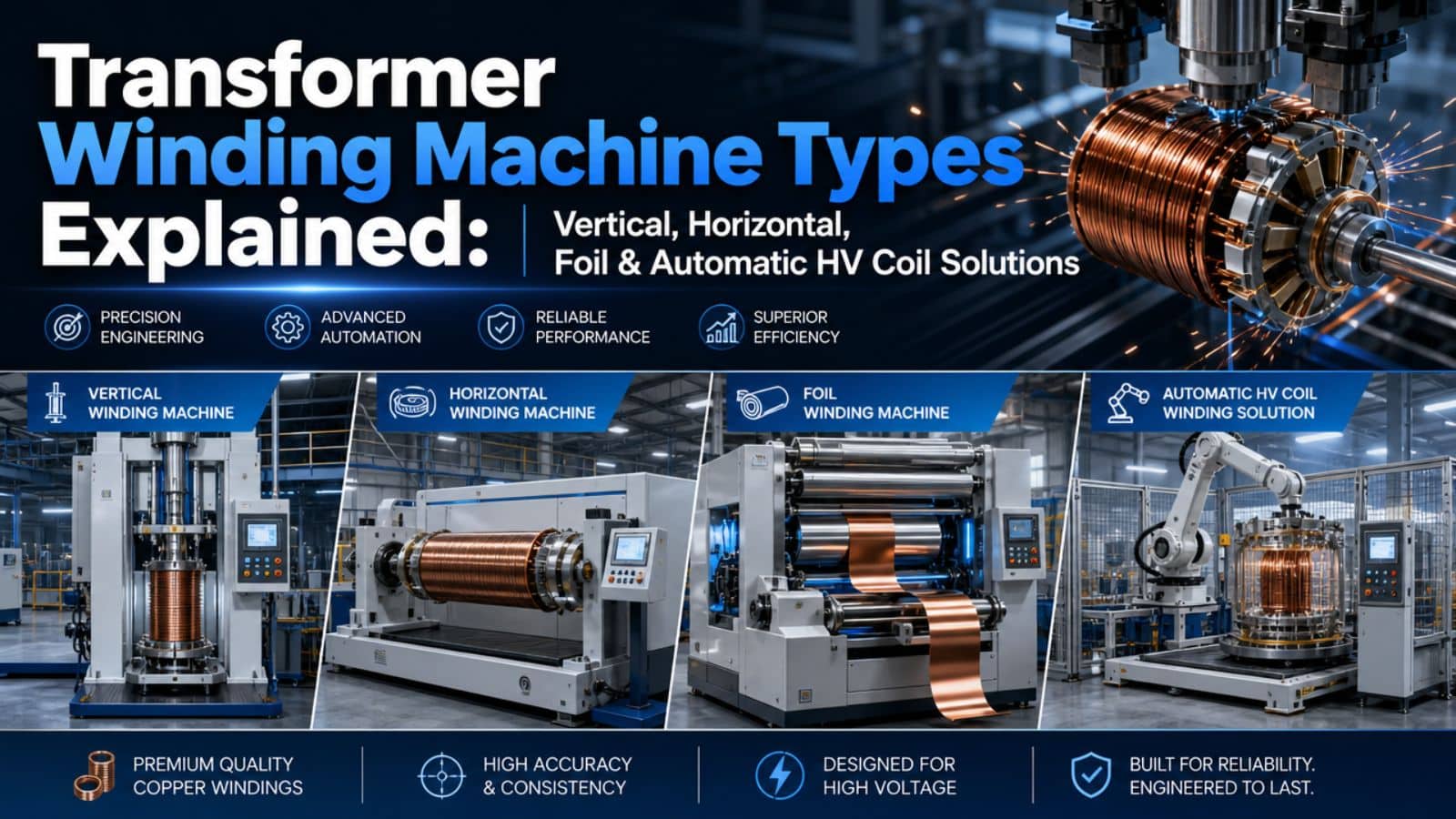
Winding is where conductor and insulation come together into the functional heart of the transformer. Your winding department needs machines matched to your product voltage class and conductor type.
Core machines:
- Vertical Winding Machine – for tall, high-voltage disc and layer windings
- Horizontal Winding Machine – for wide, low-voltage helical and layer windings
- Single / Double Layer Foil Winding Machine – for foil-type LV windings in distribution transformers
- Automatic High Voltage Winding Machine (large and distribution variants) – for programmable, high-precision HV winding with automatic insulation insertion
- Core Coil Winding Machine 3D – for reactor and specialty non-cylindrical coils
- Wire Taping Machine – for lead insulation and junction taping
Selection tip: Match mandrel diameter range and coil weight capacity to your heaviest design. A machine that cannot handle your largest planned coil is a bottleneck waiting to happen.
Category 2: Core Manufacturing Equipment
The magnetic core accounts for a significant share of transformer no-load loss. Core manufacturing precision—cut angle, burr height, stacking factor, and lamination alignment—directly impacts efficiency and noise.
Core machines:
- Iron Core Stacking and Turning Table – supports manual or semi-automatic lamination stacking with rotation for access
- Core Binding Machine – applies steel banding or glass-fiber tape to bind the finished core
- Transformer Corn Cutting Line (with sub-lines for center position, servo sorting, side position, and center piece cutting) – cuts silicon steel laminations with precise angles for step-lap or mixed-lap joints
- Silicon Steel Slitting Line – slits master coils into required lamination widths
- Circular Shearing Machine – cuts curved or circular lamination segments
Selection tip: Step-lap joint designs require angular precision within ±0.05°. Verify cutting line angle accuracy and blade maintenance protocols before purchase.
Category 3: Coil Assembly & Forming Equipment
After winding and core fabrication, coils must be assembled, pressed, shaped, and prepared for final drying and impregnation.
Assembly and forming machines:
- Assembly Platform / Coil Assembly Platform – stable work surfaces for inter-winding assembly
- Coil Cross Lifting Beam – handles heavy coils without deforming winding geometry
- Constant Pressure Drying and Compaction Device – applies controlled pressure during drying to set coil dimensions
- Coil Press – mechanically compresses windings to final height before final assembly
- Coil Shaping Machine – corrects minor out-of-round conditions and sets final coil profile
- Equalizing Pipe Wrinkle Paper Winding Machine – applies crepe paper to equalizing pipes for field grading
- End Ring Equal Division Draw Line Machine – marks precise division lines on end-rings for spacer placement
- Electrostatic Ring Bundling Machine – binds electrostatic shielding rings
Selection tip: Coil pressing and compaction equipment must maintain uniform pressure across the coil face. Ask for pressure mapping data or trial compaction reports.
Category 4: Insulation Parts Processing Equipment
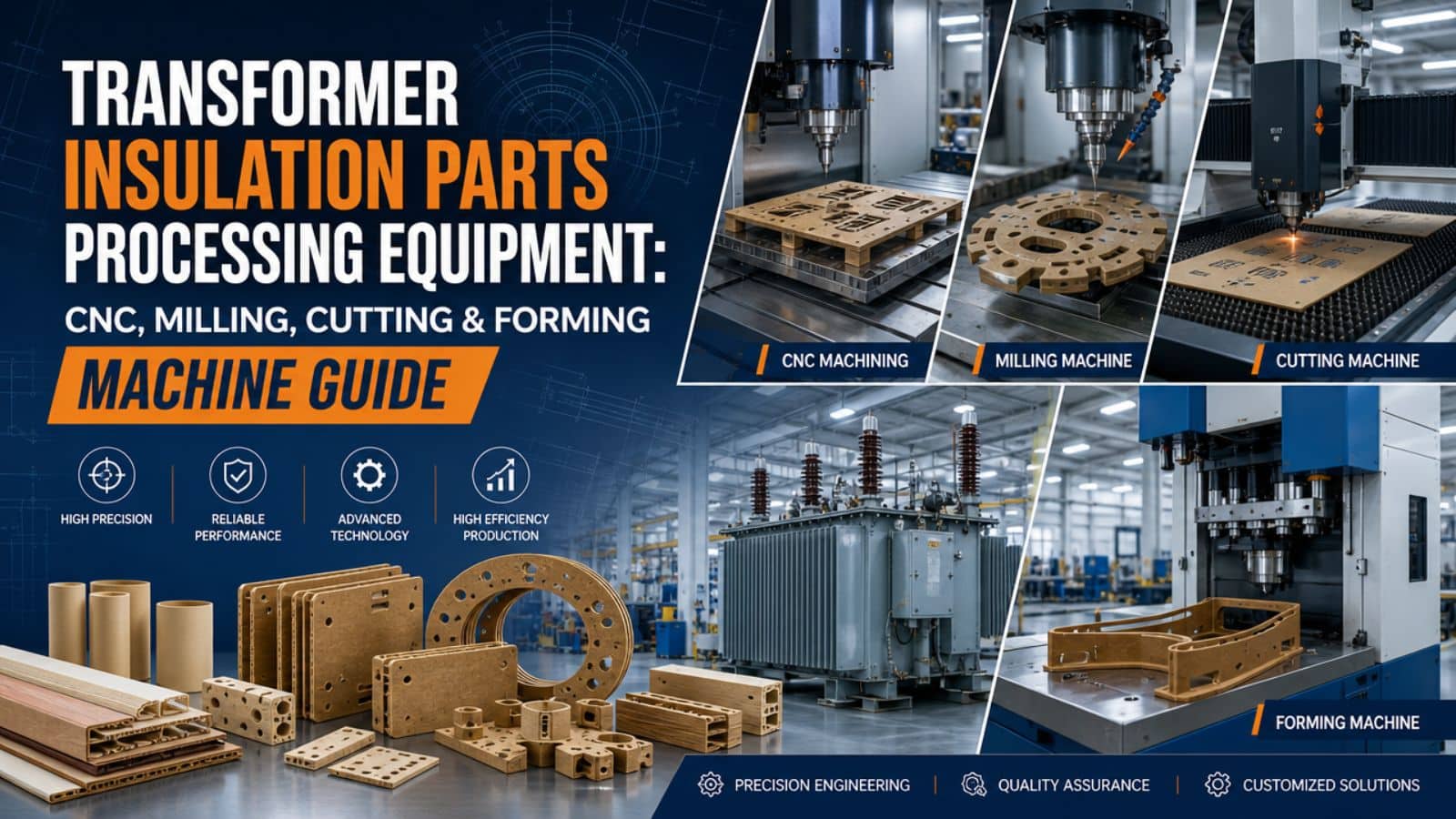
Insulation parts—spacers, cylinders, barriers, and support blocks—maintain dielectric and mechanical integrity inside the transformer.
Insulation processing machines:
- CNC Step Pad Block Machining Center – precision milling of complex support blocks
- Automatic Feeding Punching Machine – patterned hole punching in spacers and barriers
- End Insulation Bonding Machine – laminates end-support rings
- Pressboard Beveling Machine – angled edge preparation
- Cylinder Rolling Machine & Cylinder Cohesion Machine – produces bonded cylindrical liners
- Multi-Layer Heat Press Machine – laminates thick insulation plates
- Dove-tail Spacer Milling Machine – interlocking spacer production
- Insulation Parts Processing Center & Insulation Parts Sawing and Milling Combined Machine – versatile machining
- Batten Shaping Machine, Single T-Shaped Spacer Machine – profiled spacer strip production
- NC Horizontal Sawing Machine, NC Shearing Machine, Pressboard Slitting Machine, Rolling and Chamfering Machine – cutting and edge preparation
Selection tip: Dust extraction is non-negotiable. Pressboard and laminated wood machining generates fine, abrasive dust that damages bearings and creates respiratory hazards.
Category 5: Drying & Curing Equipment
Moisture in insulation is the enemy of dielectric strength. Drying and curing equipment removes moisture and cures resin or bonding agents.
Drying and curing machines:
- Constant Pressure Drying and Compaction Device (also listed in assembly) – drying under mechanical load
- HB Series Curing Oven for Transformers – general-purpose transformer coil and core drying
- HW Series Curing Oven For High-rating Generator – extended temperature and capacity for large generator-transformer sets
- HA Series Energy-saving Dipping Paint Drying Oven – post-varnish or post-oil drying with reduced energy consumption
- HRS Series Busbar Shrinkable Sleeve Oven – heat-shrinks insulation sleeves onto busbar conductors
Selection tip: Temperature uniformity matters more than peak temperature. Ask for oven uniformity surveys (typically ±3°C or better at rated temperature).
Category 6: Vacuum Treatment Equipment
Vacuum treatment removes air and moisture from insulation before oil filling or resin casting, and ensures complete impregnation.
Vacuum machines:
- Vacuum Drying Equipment – removes moisture under vacuum at elevated temperature
- Often integrated with impregnation vessels for VPI (Vacuum Pressure Impregnation) processes
Selection tip: Ultimate vacuum level and leak rate determine drying efficiency. Specify requirements based on your insulation materials and oil/resin type.
Category 7: Busbar Processing Equipment
Busbars connect transformer terminals to switchgear and must be precisely formed, punched, and insulated.
Busbar machines:
- HRS Series Busbar Shrinkable Sleeve Oven – applies heat-shrink insulation to busbar conductors
For a complete busbar shop, you would typically also include cutting, punching, and bending equipment, but the shrinkable sleeve oven is the critical insulation-finishing step.
Integration: Building a Balanced Production Line
A common mistake is over-investing in one category while under-equipping another. Use this rough capacity balance guideline:
表格
| Stage | Typical Bottleneck Risk |
|---|---|
| Core cutting & slitting | Moderate (batch process, can stockpile) |
| Winding | High (longest cycle time per unit, skill-dependent) |
| Insulation parts fab | Moderate (can outsource or run ahead) |
| Coil assembly & pressing | Low-Moderate |
| Drying / Curing / Vacuum | High (oven/vessel capacity limits throughput) |
| Final assembly & test | Moderate |
If your winding department can produce 10 coils per day but your drying ovens only handle 6, you have a mismatch. Size drying and vacuum capacity to match or exceed winding output.
Quality and Compliance Considerations
Transformer manufacturing equipment should support compliance with:
- IEC 60076 series (Power transformers)
- IEEE C57 series (IEEE transformer standards)
- ISO 9001 quality management traceability
- Customer-specific factory acceptance test (FAT) requirements
Request FAT protocols from equipment suppliers. A reputable manufacturer will demonstrate machine capability with your material samples before shipment.
Conclusion
A complete transformer manufacturing line spans Winding Equipment, Core Manufacturing Equipment, Coil Assembly & Forming Equipment, Insulation Parts Processing Equipment, Drying & Curing Equipment, Vacuum Treatment Equipment, and Busbar Processing Equipment. No single category operates in isolation; the output quality and cycle time of each stage constrain the others.
When planning your factory or upgrade, start with your product roadmap. Define the voltage classes, MVA ratings, and annual volume you intend to build. Then map each product to the required machines in all seven categories, ensuring that drying, vacuum, and winding capacities are balanced. The result is a production line that delivers consistent quality, meets delivery commitments, and scales with your business.